
AI meets System Mapping Series #3
Every mapping process has a moment we know too well. The challenge is framed, the research is done, and there are pages full of notes, interviews and data. Yet the board is still empty, and we don't quite know where to place the first variable.
In the first two articles of our AI meets System Mapping series, we took a critical look at how AI tools can support or hinder Systems Thinking and explored five roles AI can take on in a mapping process. One of these roles is the Kick-Starter, which generates a rough first map and gives the team something tangible to engage with.
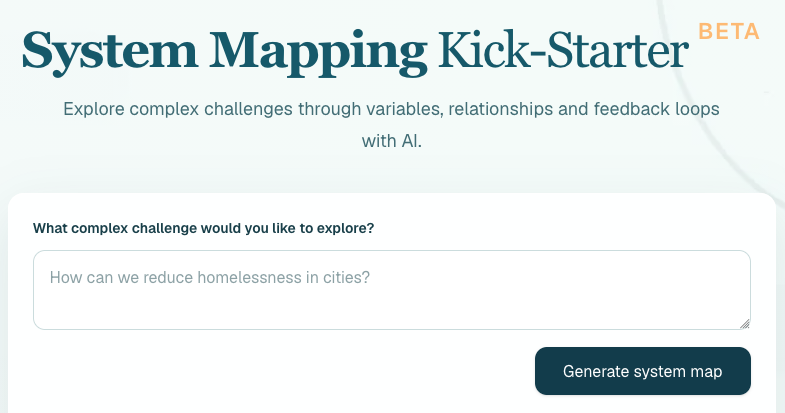
Over the past months, we have developed our own version of this role, and have now released it as the System Mapping Kick-Starter: a free web app that turns a short description of a complex challenge into a first draft of a System Map.
👉 Link to the Kick-Starter: app.system-mapping.com
What the Kick-Starter does
Describe your challenge in one or two sentences, and the Kick-Starter generates a causal loop diagram with variables, relationships and feedback loops. You can then edit the map and export it to Miro to keep working on it.
We aimed to build a tool that invites critical thinking instead of replacing it. Our approach was to make the reasoning of the model as visible as possible. Each map shows an explanation for each variable, relationship and feedback loop, a list of underlying assumptions the model made, and open questions that only people who know the system can answer.
The tool keeps the map small and simple, so not every important aspect will be included. This keeps the map easy to digest and leaves room for discussion and adjustments. The assumptions and open questions point to some of the blank spaces worth investigating.
Let’s look at an example map in the Kick-Starter. We asked it the following question: Why does affordable housing stay scarce?
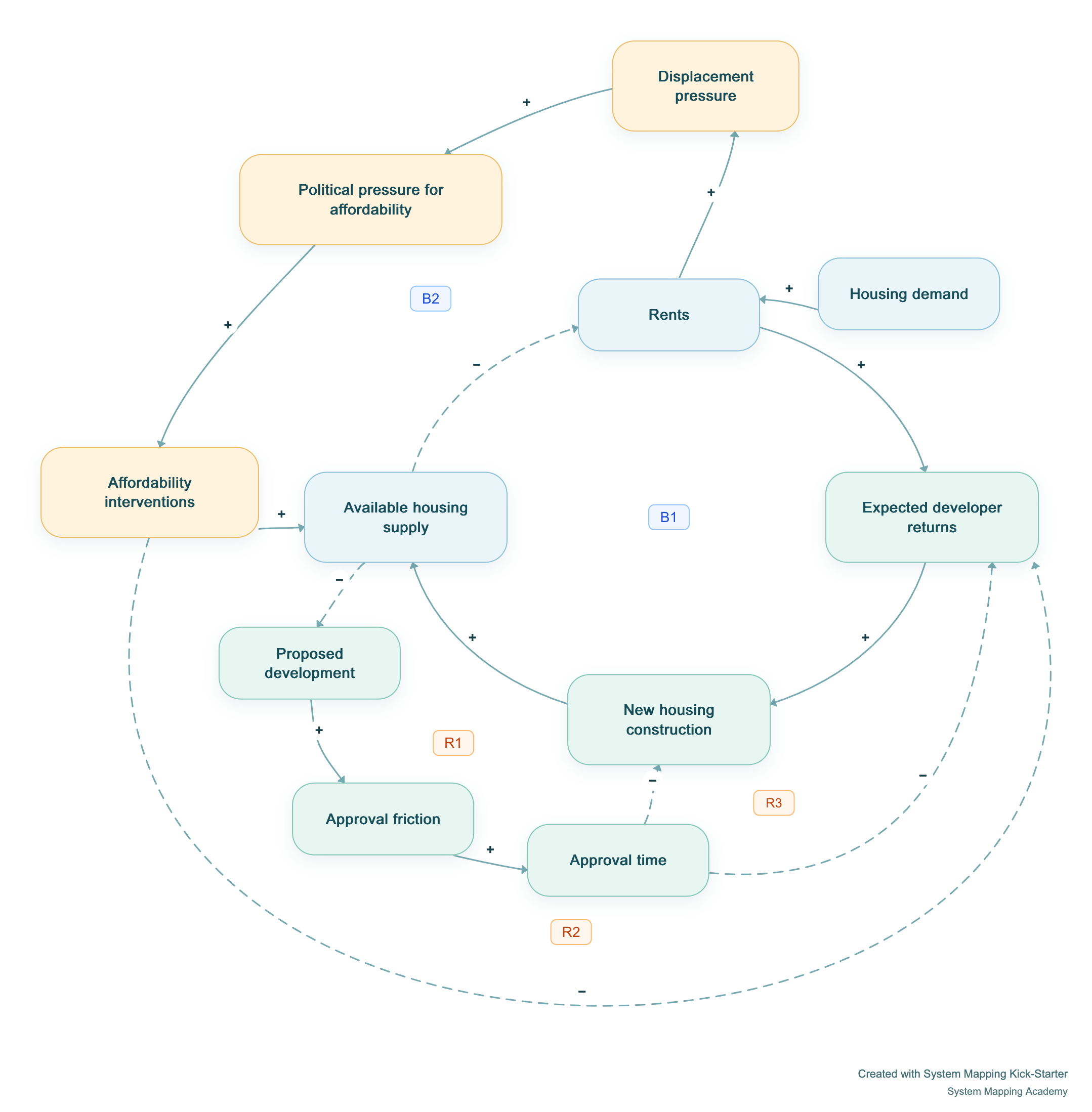
The result is a simple map that connects the housing market, the development pipeline and the political response. Some of it is convincing. The map reflects the delays in the approval process, and picks up a dynamic that could be easily overlooked: affordability interventions can lower developer returns and with them new construction, which in turn increases the pressure for further interventions. The assumptions invite deeper reflection, for example that additional supply only eases rent pressure when homes are suitable and accessible to the households seeking them.
What is missing is equally important. Housing demand is treated as a constant, and land prices, construction costs and financing do not appear. The map follows a market logic, with little room for social housing or informal housing, which shape access to housing in many parts of the world. And the people most affected appear only as "displacement pressure". These gaps are where the conversation with stakeholders should begin.
How a quick first map can help
In our own projects and experiments, a generated first draft proved useful in several ways.
Overcoming the Blank Page. Starting a System Map from scratch can be paralysing, and collecting variables and sketching first relationships can take days. With a first draft, you have a structure to work with right away and can test it against your own research and understanding of the system.
Finding the Right Level of Detail. Two of the most difficult decisions in any mapping process are how far to zoom out and where to draw the boundary of the system. The Kick-Starter makes a proposal for both. It will rarely fit your context perfectly, but once the proposal is visible, the group can discuss and adjust it.
Opening the Discussion. A first draft lowers the threshold to take part. Participants who are unsure where to start on an empty board are often quick to point out what is missing or wrong. This idea has a long tradition in group model building: in one of Richardson and Andersen's workshops, a preliminary model looked familiar but fell short, and "discussion of how to improve it began immediately".
Getting to Know the Method. For people who are new to System Mapping, the Kick-Starter offers a quick way to see what a System Map can add to their own expertise. For example, try it on a topic you know well. Instead of separate causes and effects, the map shows how factors reinforce or balance each other over time, and why some problems persist despite everyone's efforts. At the same time, your expertise lets you quickly see where the model gets things wrong or keeps them too simple. Both are valuable lessons.
Why care is still needed
Everything we wrote in our first article about the risks of AI in System Mapping still applies. With the Kick-Starter, four points seem particularly important to us.
A First Draft Can Become an Anchor. Once a map is on the board, groups might adjust it rather than question it fundamentally. Richardson and Andersen observed this long before AI: in one of their workshops, the preliminary model they used to start the session "biased the group" toward explanations from outside the system.
Learning Needs Friction. Much of the learning in System Mapping happens in the struggle: deciding what to include, disagreeing about a connection, shifting perspectives, identifying feedback loops. If a tool removes this friction entirely, much of the learning can disappear with it.
Action Needs Ownership. Stakeholders are far more likely to accept and act on insights they have developed themselves. A map that comes out of a machine will rarely carry the same weight in a group as one its members have built together.
AI Makes Mistakes. This is especially true for details and precision. A relationship might point in the wrong direction, or a feedback loop might be marked as the wrong type. AI has improved a lot in this regard, but a generated map can still lead to wrong conclusions.
That is why one of the orientations from our first article remains central for us: treat AI output as a starting point, not an answer. A generated map is there to be questioned, changed and, if necessary, discarded.
How to use the Kick-Starter
We kept the Kick-Starter as simple as possible. You see the map in the centre with the key feedback loops, assumptions and open questions on the left. By hovering over a variable, relationship or feedback loop, you can read why the model included it.
You can also move variables and connections around to make the map easier to read. The layout is created by our own layout engine, which works well in most cases but is not free of errors. If the map gets messy, the "Reset layout" button may help.
We designed the Kick-Starter as part of a bigger mapping process. Once exported to Miro, your map connects directly to our System Mapping Toolkit, which guides you through the whole mapping process. The Kick-Starter fits right in by providing a quick first draft for the mapping phase.
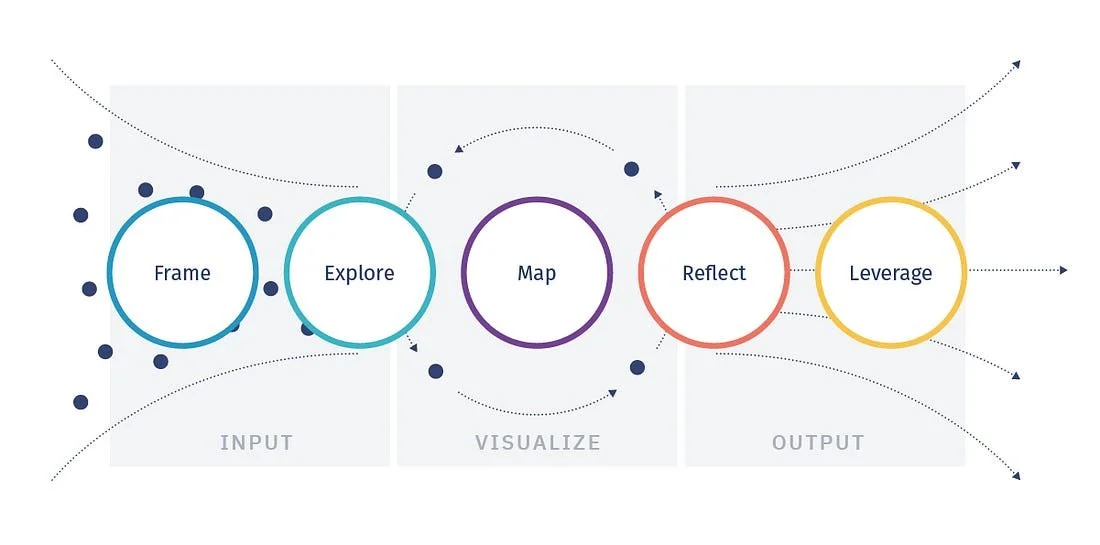
In our own practice, we see three moments in which the Kick-Starter can be particularly helpful:
Before a Workshop. Facilitators can use it to prepare a session and get a feel for the topic, without necessarily showing the result to participants.
During a Workshop. Show the generated map and ask one simple question: What is wrong with this map?
After a Mapping Session. Once a group has developed its own map, the Kick-Starter can offer a second opinion and help to check for blind spots. This way, the group's own thinking comes first.
From Kick-Starter to Project Assistant
The Kick-Starter is still a beta version that we continue to develop and expand. In the coming months, we want to explore how it could grow into a project assistant that supports you in your mapping process. Some of the ideas we are currently experimenting with:
guiding users step by step through framing, boundaries, variables, feedback loops and leverage points
building maps based on your own research and documents instead of the model's general knowledge
integrating the perspectives of different stakeholders, building on what we described as the Perspective-Shifter
saving your maps to continue working on them later
If you want to dive deeper into the world of System Mapping and AI, two of our trainings may be of interest. Our System Mapping Training introduces the method step by step in three live online sessions, from framing a challenge to identifying leverage points.
Our System Mapping & AI Training focuses on the roles AI can play in the mapping process, including the Kick-Starter, and on where AI strengthens good systems practice and where it gets in the way.
We are curious to hear your thoughts. Where do you see the greatest value of AI in the System Mapping process? And how does the Kick-Starter hold up with your own challenges? Following Donella Meadows' advice to "get your model out there where it can be shot at", we would love to hear what works for you and what doesn't. Write to us at hello@system-mapping.de.